
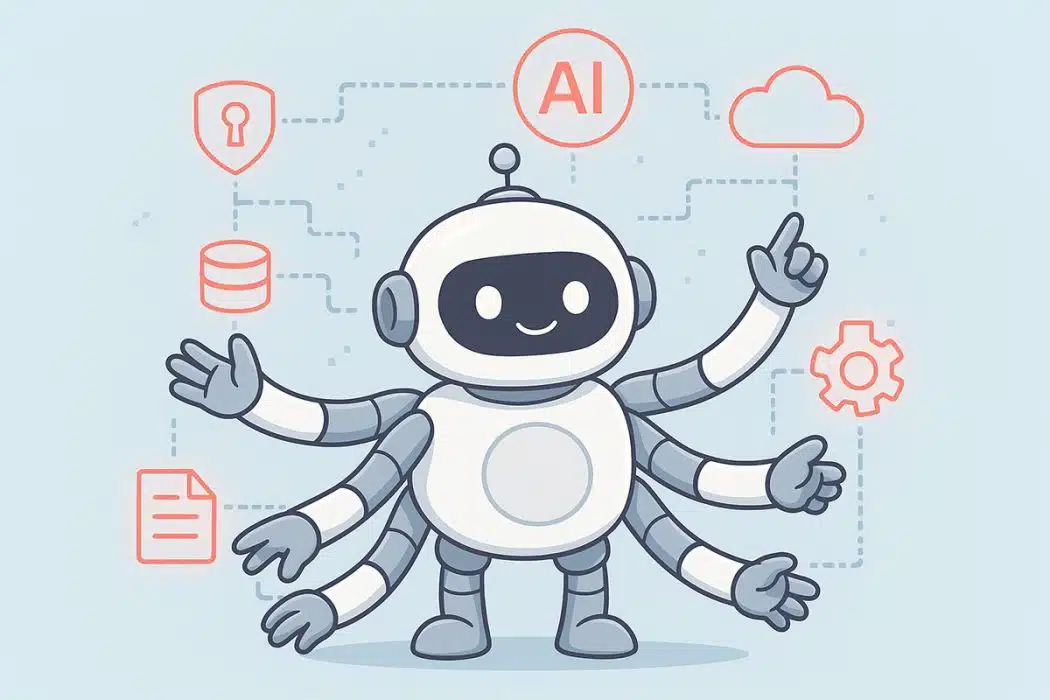
How a New AI Standard Will Reshape Enterprise Efficiency, Data Strategy, and Competitive Advantage
Artificial intelligence is evolving beyond tools and models into full business ecosystems. For B2B companies, the next decade will be defined by how effectively they integrate AI into their workflows, customer experiences, operations, and technical environments. Yet most organizations are still stuck at the same early stage: experimenting with AI tools rather than building an AI infrastructure capable of producing real operational advantage.
The Model Context Protocol (MCP) represents the next significant shift in enterprise AI. Unlike individual models or chat interfaces, MCP is an open standard that allows AI systems to safely and securely interact with an organization’s data, tools, and operational environment. It is a protocol designed for interoperability, security, and operational automation at scale.
For executive teams evaluating how to modernize workflows, increase efficiency, or prepare their organizations for AI driven markets, understanding MCP is not optional. It is foundational. MCP will influence enterprise architectures in the same way APIs, cloud services, and mobile platforms reshaped the previous generation of digital transformation.
This article explains MCP in clear strategic terms, shows how it applies to B2B organizations, and outlines how leaders can begin leveraging MCP to gain a competitive advantage.
Part 1: What MCP Actually Is
Most business leaders currently interact with AI through tools such as ChatGPT, Claude, Perplexity, or specialized enterprise platforms. These tools can answer questions, generate content, or summarize information, but they generally operate as isolated applications. They are powerful, but not yet fully integrated into day to day operations.
The Model Context Protocol changes this dynamic.
At its core, MCP is a technical specification that allows AI systems to:
• Access data sources directly
• Interact with software tools
• Perform defined operations safely and with permission
• Maintain structured context while doing so
• Integrate into enterprise systems in a consistent and auditable way
The easiest way to think about MCP is this.
If APIs were the connective tissue of the cloud era, MCP is the connective tissue of the AI agent era.
APIs allow software systems to talk to each other. MCP allows AI systems to talk to software systems, databases, and tools in a controlled and standardized way.
This may sound like a technical nuance, but it creates an architectural shift.
AI is no longer a separate application used by humans. AI becomes an operational layer inside the business, capable of retrieving data, performing tasks, and triggering workflows. And it does this within permissions, security boundaries, and compliance requirements defined by the organization.
That distinction is why MCP matters for leaders, not just engineers.
Part 2: Why MCP Matters for B2B Enterprises
The B2B marketplace is being reshaped by AI driven expectations. Companies want faster onboarding, richer data insights, accelerated procurement cycles, continuous training, and proactive communication from vendors. Internally, teams need better decision support, more automation, and fewer manual processes.
MCP enables both external and internal transformation by solving five persistent problems in enterprise AI adoption.
1. AI has limited access to enterprise systems
Most AI tools operate in isolation. They cannot read your ERP data, cannot update CRM records, cannot run internal reports, cannot access your knowledge base, and cannot interact with your proprietary tools. MCP removes this limitation by creating a secure bridge between AI models and enterprise tools.
2. AI lacks domain context
Large language models are generalists. They know how to write, analyze, and reason, but they do not know your business unless you manually feed them information. MCP introduces persistent and structured domain context that travels with the AI, ensuring consistent accuracy.
3. AI tools do not integrate into existing workflows
AI does not improve efficiency if employees must copy and paste content into a chatbot. MCP turns AI into a workflow participant that plugs directly into operational tools.
4. Security and compliance concerns limit adoption
Executives hesitate to expose internal data to AI systems for good reason. MCP solves this through controlled permissions and a standardized access layer. It allows organizations to define exactly what an AI system can see and what operations it can perform.
5. AI value is not compounding
Without deeper integration, AI becomes a novelty rather than an operational force multiplier. MCP supports compounding ROI by enabling:
• System level automation
• Cross functional workflows
• Enterprise memory
• Repeatable processes
• Continuous improvement loops
For B2B companies, this creates a new category of competitive advantage based not on marketing channels or product features, but on operational intelligence.
Part 3: How MCP Works in Practice
To understand MCP in action, imagine an AI agent operating with controlled access inside your company’s environment. It has the ability to:
• Read data from your CRM
• Summarize activities from your project management tool
• Pull financial records from your accounting system
• Draft reports based on internal templates
• Update records with proper audit trails
• Trigger workflows within approved boundaries
• Retrieve knowledge base articles for employees or customers
All of this is performed through MCP connectors defined by your engineering team or your technology partners.
MCP does not replace existing systems. It enables AI to interact with them safely.
In practice, MCP uses four core components:
1. Resources
Data sources that an AI system can read. Examples: CRMs, ERPs, documentation repositories, data warehouses, shared drives.
2. Tools
Actions an AI system is allowed to execute. Examples: create a new ticket, update a CRM contact, draft a contract from a template, schedule a meeting, run a financial report.
3. Prompts
Predefined structures that ensure consistent and accurate outputs. Prompts become reusable instructions that embed company standards.
4. Sessions
A controlled environment where the AI system interacts with tools and data. Everything is logged, permissions governed, and context preserved.
Together, these elements create a secure, auditable, operational AI layer within the business.
Part 4: Strategic Use Cases for B2B Leaders
MCP opens a wide range of high value use cases across the enterprise. These are not speculative. They are practical, near term, and already emerging within early adopters.
1. Sales Operations
AI becomes a true revenue operations assistant. MCP enables AI to:
• Pull CRM activity and summarize pipeline health
• Draft sales emails using account history
• Build account plans from internal templates
• Analyze forecast accuracy
• Update CRM fields with clean, structured data
• Build proposals from product catalogs and pricing rules
Result: better pipeline accuracy, higher sales productivity, and cleaner CRM data.
2. Customer Success
AI can take on large portions of routine tasks. MCP enables it to:
• Review support tickets and identify themes
• Draft QBR decks using customer usage data
• Monitor account risks using internal signals
• Summarize contracts or renewals
• Prepare onboarding steps for new accounts
Result: higher retention and better customer experience.
3. Professional Services and Delivery
AI can sit inside project workflows. MCP enables it to:
• Read project management data
• Flag risks based on budget and timeline trends
• Prepare status reports
• Draft meeting agendas from task boards
• Identify overdue tasks and notify owners
• Extract insights from time tracking data
Result: improved delivery consistency and reduced administrative overhead.
4. Finance and Accounting
AI becomes a support layer for financial operations. MCP enables it to:
• Pull invoices and categorize them
• Draft financial summaries
• Reconcile transactions using internal rules
• Identify anomalies in cash flow or expenses
• Prepare budget variance reports
Result: faster reporting cycles and greater financial accuracy.
5. HR and Talent
AI reduces administrative load and supports employee experience. MCP enables it to:
• Draft job descriptions
• Summarize performance reviews
• Prepare onboarding checklists
• Analyze turnover patterns
• Compile training resources
Result: more strategic HR operations.
6. IT and Security
AI becomes a tier one support and monitoring layer. MCP enables it to:
• Read logs
• Surface anomalies
• Suggest remediation steps
• Draft incident reports
• Monitor tools for downtime patterns
Result: improved system reliability and help desk efficiency.
Part 5: The Executive Impact
The C suite cares about outcomes. MCP affects three strategic categories: operational efficiency, revenue growth, and competitive differentiation.
1. Operational Efficiency
AI becomes a participant in workflows, not a separate tool.
Typical efficiency impacts include:
• 30 to 70 percent reduction in routine administrative work
• Shorter cycle times for reporting, communication, and reviews
• Higher data accuracy across systems
• Lower operational friction across departments
This is not automation in the traditional sense. It is dynamic, intelligent workflow participation.
2. Revenue Growth
MCP does not directly generate revenue, but it amplifies the systems that do.
Revenue gains emerge from:
• Higher sales productivity
• More accurate forecasts
• Faster proposal creation
• Better retention performance
• Greater customer lifetime value
Companies that adopt MCP early will see a compounding advantage as AI powered workflows mature.
3. Competitive Differentiation
Most companies will spend years experimenting with AI tools.
Few will integrate AI into the actual operating system of the business.
MCP allows an organization to:
• Move from tool adoption to system transformation
• Build proprietary AI workflows that competitors cannot easily replicate
• Create a more predictable, data driven operating rhythm
• Strengthen cross functional collaboration
This is a differentiator on the same level as cloud transformation in the 2010s.
Part 6: The Organizational Roadmap
B2B leaders do not need to adopt MCP overnight. A phased roadmap is more practical and creates better long term outcomes.
Phase 1: Awareness and Strategy
Leaders begin by defining:
• Where AI can reduce costs
• Where AI can improve customer experience
• Which workflows are ideal for augmentation
• Which data sources require structured access
• Which risks must be mitigated
Outcome: a clear strategic direction without technical complexity.
Phase 2: MCP Readiness Assessment
Technical teams or external partners evaluate:
• Data locations
• Tools with available integrations
• Security requirements
• Permission structures
• Internal knowledge sources
• Technical constraints within legacy systems
Outcome: a prioritized list of AI accessible systems.
Phase 3: High Value Use Case Pilots
Start with two or three workflows that offer measurable ROI.
Examples:
• Sales forecasting
• Customer success QBR generation
• Project status reporting
• Financial reconciliation
• Support ticket summarization
Outcome: real operational gains with low risk.
Phase 4: Enterprise Integration
Once value is proven, expand MCP across:
• Departments
• Data sources
• Tools
• Workflows
• Use case libraries
Outcome: AI becomes part of the operating rhythm of the company.
Phase 5: Autonomous Workflow Design
The long term destination is AI orchestrated workflows where human expertise remains in control of final decisions. MCP allows this by:
• Triggering events
• Monitoring data flows
• Executing tasks
• Requesting approvals
• Maintaining audit trails
Outcome: a hybrid operational model where humans and AI collaborate intelligently.
Part 7: Core Risks and Governance
No enterprise technology deployment is complete without addressing risk. Leaders must prepare for the following categories.
1. Data Privacy
AI must only access what it is explicitly permissioned to see. MCP supports these boundaries, but governance policies must enforce them.
2. Authentication and Authorization
Proper identity management is essential. Every AI action should be attributable and auditable.
3. System Complexity
AI should simplify workflows, not add layers of complexity. Early architectural decisions matter.
4. Overautomation
AI is a powerful tool, but poor design can create brittle workflows. Human oversight is essential for decision points, exceptions, and strategic judgment.
5. Change Management
Teams must understand how AI supports them. If employees believe AI is replacing them rather than assisting them, adoption will stall.
A strong governance framework will help accelerate adoption, not slow it.
Part 8: What This Means for B2B Leaders
MCP signals a new maturity level in the AI ecosystem. It is not simply another tool or feature. It is an infrastructure layer that will define how B2B organizations operate. Leaders who understand and adopt MCP early will position their companies for a future where intelligent workflows, embedded AI, and adaptive systems become the norm.
Executives should view MCP as:
• The foundation of an AI ready enterprise
• The key to unlocking operational automation
• A pathway to more accurate decision making
• A competitive moat built around proprietary data and workflows
• A critical step in future proofing the business
AI will not replace businesses.
But businesses that integrate AI deeply will outperform those that stop at experimentation.
MCP is the bridge from experimentation to transformation.
Final Thought for MODEFORGE Publication
MODEFORGE advises B2B and B2G clients on AI strategy, visibility engineering, and the adoption of emerging technologies such as MCP. For organizations preparing for AI driven competition, the time to build an MCP informed strategy is now. Leaders who move early will gain the greatest returns in efficiency, capability, and competitive advantage.
If you would like a follow up article, excerpt posts for LinkedIn, or a downloadable PDF executive summary, I can generate each of those as well.
About The Author
Mark Senefsky
Strategic Marketing leader with over 30 years of experience connecting brands and their customers. My vision and leadership help companies adopt and leverage established and emergent marketing strategies to increase profitability, productivity and significant competitive advantage.